
Press release:
Wereldmuseum Amsterdam is thrilled to present Rogue Agents of History, the first major solo exhibition in the Netherlands by Palestinian artist and filmmaker Larissa Sansour, curated by Nat Muller. Bringing together film, sculpture, photography and historical objects, the exhibition premieres A Sunken Tale of Losses Delayed (2026), a new commission developed with writer and filmmaker Søren Lind.
Across multiple timelines — from Ottoman histories and present-day geopolitics to imagined futures — the exhibition explores how art and film can unsettle official narratives, recreate historical meaning and open space for other possible pasts and futures. Through speculative fiction, archaeology, memory and material culture, Sansour’s work asks who has the right to history, and how that history might be retold.
Pirates, ghosts and guerrilla archaeologists populate the world of Rogue Agents of History. These “rogue agents” seize, disrupt and reimagine historical narratives, reclaiming the past in order to transform the future.
Rooted in the Palestinian context yet resonating far beyond it, the exhibition explores universal questions of identity, belonging, memory and loss. Science fiction — a genre Sansour has embraced throughout her career — becomes a critical tool for examining how histories are constructed and how they might be rewritten.
Central to the exhibition is the relationship between film and material culture. Historical artefacts from collections of Wereldmuseum, Museum Catharijneconvent, and the National Maritime Museum appear alongside artworks, personal heirlooms and film props. These objects inhabit multiple timelines and narratives, deliberately blurring the boundaries between fact and fiction.
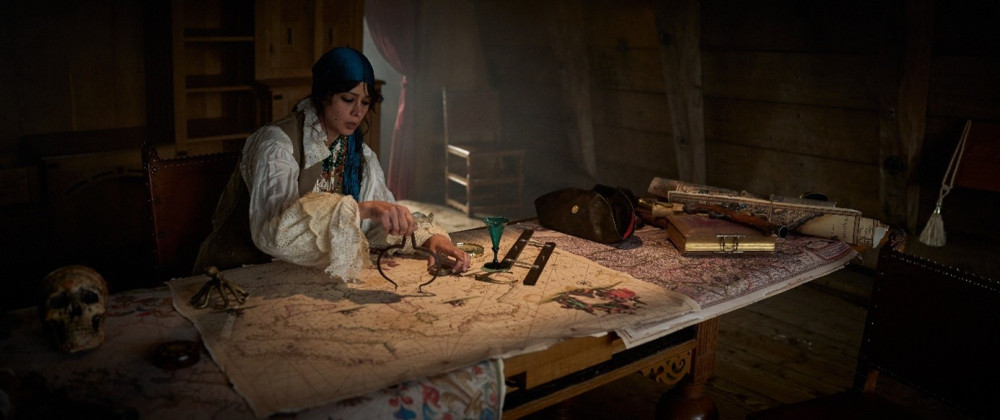
At the centre of the exhibition is the world premiere of A Sunken Tale of Losses Delayed (2026), a new film by Sansour and Lind commissioned by Wereldmuseum Amsterdam.
Set aboard a ghostly Palestinian pirate ship travelling across centuries, the film follows a crew of spectral sailors who retrieve lost objects, displaced memories and forgotten histories drifting through time. As the vessel moves between eras, fragments of Palestinian cultural heritage intersect with maritime histories connected to the Netherlands, the Mediterranean and beyond.
Filmed partly in locations tied to Dutch colonial history — including the depot of Wereldmuseum Amsterdam, KIT (Royal Tropical Institute), the National Maritime Museum and the VOC ship replica Batavia — the work reflects on the circulation of objects, stories and identities across empires, oceans and archives. In the film, characters use and handle objects, restoring them to their functional state while also giving them new roles within the cinematic world. These objects—already rich with history and layered meanings—gain an additional dimension as they move across contexts, from museum collection to film set to gallery space.
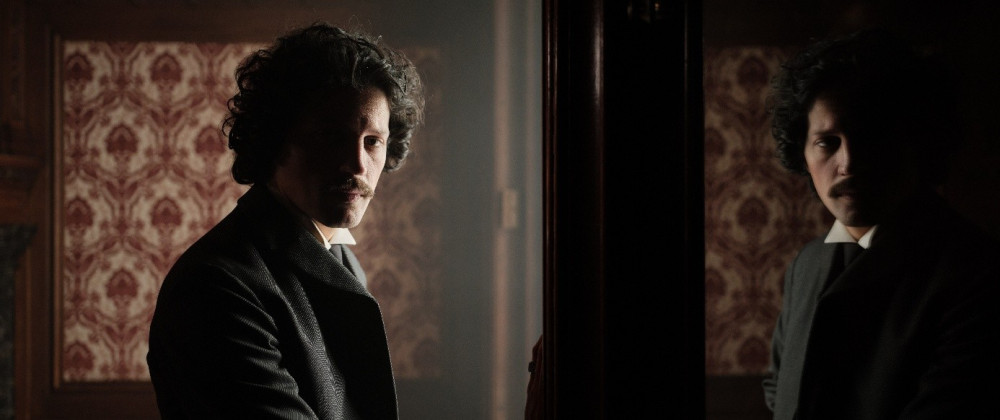
The film features Maisa Abd Elhadi, the acclaimed Palestinian actress known for her powerful screen performances, alongside Fadi Abdel Shafi, whose presence brings a sharp contemporary energy to the film’s speculative world. Their performances anchor a cinematic universe that combines historical fiction, political allegory and theatrical spectacle.
Through this imaginative framework, the film asks urgent questions about the ownership of history: who writes it, who controls it, and who has the power to reclaim it.
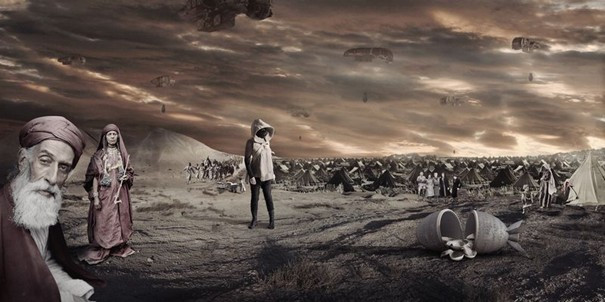
Sansour began working with video in the early 2000s during the Second Intifada, when the urgency of documenting life under occupation initially drew her to documentary film. Over time, however, she turned to fiction — and specifically science fiction — as a way of addressing dimensions of Palestinian experience that documentary alone could not capture. It is precisely in this imaginative space that archaeology, myth and storytelling converge in her wider practice: across earlier works such as In the Future They Ate from the Finest Porcelain (2016) and Familiar Phantoms (2022), which are also presented in this exhibition, Sansour explores how objects, memories and inherited narratives move through time, acquiring new meanings as they resurface in different historical and emotional contexts.
In In the Future They Ate from the Finest Porcelain, a resistance group buries porcelain plates in the desert to create archaeological evidence for a future civilisation. In Familiar Phantoms, the artist turns toward childhood memory and family archives, weaving together personal and collective histories of displacement. Together with the new film, these works form a constellation of narratives unfolding across past, present and future. By destabilising linear time and merging fiction with historical fact, Rogue Agents of History proposes imagination as a way of recreating history itself — opening new horizons of possibility in an increasingly fraught geopolitical landscape.
Rather than simply recording what is being lost, her work constructs cinematic worlds that challenge dominant narratives and create new visual languages for Palestinian history.
Through speculative narratives, archaeological metaphors and carefully constructed fictional universes, Sansour’s work explores inherited trauma, collective memory and the persistent struggle for historical agency. By bringing film, material culture and memory into dialogue, she positions imagination as a vital mode of repair — a way of reclaiming agency, reanimating archives and shaping different relationships between past, present and future within an increasingly fraught geopolitical landscape.
In a building marked by a colonial origin story, Wereldmuseum chooses nuance, accountability and imagination. Sansour’s practice aligns closely to this course: through speculative fiction and material culture, she opens new ways of reading how histories are constructed — and how they might be rewritten. In this spirit, Rogue Agents of History continues the museum’s trajectory of working with contemporary artists who unsettle dominant narratives and bring new agency to historical objects.
This exhibition and collaboration are an invitation to imagine what a more equitable and just world could look like — and to foster the kind of global citizenship that makes such a future possible.
Wereldmuseum Amsterdam — part of one museum with four locations in Amsterdam, Leiden, Nijmegen and Rotterdam — connects contemporary art with historical collections to open new perspectives on cultures and histories, deepening appreciation for the fragile beauty of the worlds we inhabit, and contributing to a more equitable and just future. By inviting artists whose work challenges dominant narratives, the museum brings new perspectives to light — not as additions to an established canon, but as starting points for better understanding the world around us.